This page is dedicated to always free resources for coaches looking to improve their cognitive training programs. These resources are ever changing and will be updated as more knowledge regarding cognitive training becomes available.
Coach Kat’s Approach
My approach to creating training drills and programs has developed to incorporate various key experiences. This includes my background as an athlete, a world-class dog trainer, a strength and conditioning coach, and a performance psychology professional. I aim to create evidence-based, near-transfer-focused, and contextually relevant training drills to enhance cognitive skills and allow for practice applying mental skills. Depending on your population, you may wish to adapt or recreate the drills I share to be more specific to your population and the psychological, cognitive, and physical demands they must handle to perform at their best.
I will include recommendations for progressing and regressing drills, incorporating various relevant stressors, and debriefing the session. When applicable, you will find a tutorial on how to build the drill for your population.
While there is little research on building cognitive training drills that support my aim, I will link to relevant articles to help coaches understand my approach and rationale behind drills created. I believe in out-growing my own work and fully anticipate that the drills below will one day be “outdated” by my standards and the community’s standards. For now, they are my best efforts to trend in the right direction and inspire change.
To better understand my approach to building cognitive training drills and programs, please watch our presentation at the 2023 Tactical Annual Training.
Exploring Integration Strategies for Physical, Tactical, and Cognitive
Watch Here: https://vimeo.com/user18890974/review/861455407/d871522879
Terms to Know
Cognitive functions are fundamental mental processes underlying human thought and behavior. These are the basic mechanisms by which the brain operates and are considered innate or hard-wired capabilities of the brain.
Cognitive skills are specific learned abilities that a person can develop and improve through practice and experience. These skills are built upon the foundational cognitive functions and are more about how effectively these functions are utilized in specific tasks.
Mental skills refer to psychological strategies and techniques used to optimize one’s mental state, particularly in performance settings.
Team Training Sessions
Prompting teamwork and communication are common goals for cognitive or mental training sessions. There are a few ways we can elevate these training sessions to increase the contextual relevancy of the training session and allow leaders and team members to refine their skills.
Consider the mission planning principles of the organization you support.
For instance, we may have a platoon of 24 to 36 soldiers with a precise rank structure in the US Army. The platoon leader and platoon sergeant have four squad leaders below them, with two team leaders per squad and several riflemen (or other roles) on each team. The PL and PSG would brief the squad leaders responsible for deducing relevant information to be given to their team leaders to pass along to the team. This intentional communication structure ensures each soldier can maintain situational awareness, work in a coordinated fashion, and act with the commander’s intent.
Allowing the PL & PSG to take the lead in briefing their platoon may provide greater value to the team and more realistic practice than the CPS delivering the instructions or splitting team members into random training groups. There is a time and place for random group assignments if the training schedule allows…however, prioritizing communicating within the structure of the unit is advised. For instance, splitting up the crew of an Abrams tank would not provide as much value to the team as having the commander, driver, loader and gunner refine their communication between one another.
Educate yourself on the mission planning principles of the organization you serve. Utilizing the 8 Troop Leading Procedures (TLPs) would have high relevancy for an infantry platoon, applying these principles with Space Force Guardians would be ignorant as they rely on different mission planning principles.
Allow military doctrine to inform your training plan.
Completing multiple training sessions allows you to consider what roles and responsibilities would fall on team members throughout a combat deployment or specific engagement.
For instance, throughout multiple training sessions or rounds within a session, depending on the readiness of the soldiers, soldiers can be tasked to take on leadership roles beyond their rank. ADP 6-0 implies that soldiers should be prepared to step up and assume higher responsibilities if the situation demands it, especially in the absence of direct orders or when immediate action is necessary to achieve mission objectives or ensure the unit’s safety. Soldiers should be able and ready to assume the role of someone two positions above them (e.g., a team leader takes the role of the PSG). This provides a realistic challenge to communication and leadership skills while preparing soldiers for their future roles as they progress through their careers.
I recommend working with a tactical professional to incorporate guidance from doctrine and mission planning elements into your training sessions to increase contextual relevancy and value.
Choose relevant tasks to increase buy-in and realism of the session.
The CPS is responsible for developing a deep and thorough understanding of the tactical tasks, the context of operations, and the combat environment. Your ability to provide sessions with the most significant value depends on this.
Do not rely on irrelevant, far-transfer tasks, like pipeline or toxic waste, to facilitate teamwork sessions. Create tasks independently or integrate a tactical professional to choose relevant tasks that move you closer to providing near-transfer training.
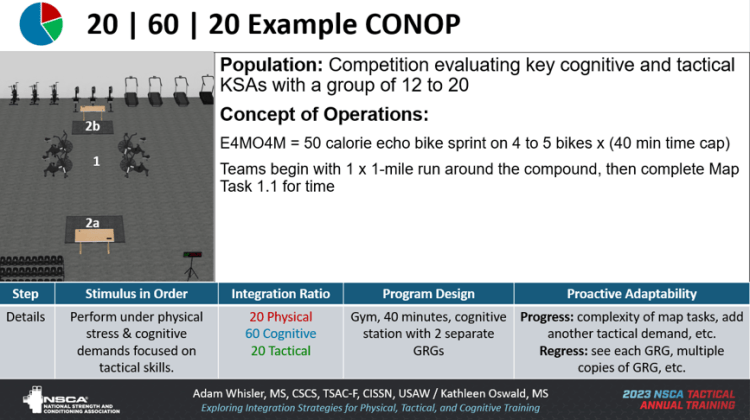
This example session leverages knowledge about mission planning and operations of an infantry platoon to provide a realistic scenario for training and discussion.
Task 1: Map Task 1.1
This task was initially designed for SF Operators and targets several cognitive skills. The emphasis was on spatial awareness, working memory, and critical thinking.
Appropriate as-is for warfighters training for urban combat. This drill was designed to be used by one individual or in pairs during the rest period of workouts in the gym.
To regress the difficulty, eliminate the physical stress and complete this drill in a cognitive-focused training session. To increase the difficulty of this drill, add relevant stressors to the physical stress of the workout. Such as having a platoon sergeant or team sergeant ask the questions (e.g., “Alpha, this is Zulu, which builds have been cleared?”) or putting a time-cap on each section of the worksheet.
This was built using Google Street View screenshots and Canva to create maps. If you create your own map tasks, you can upgrade the quality of the maps to generate a nearer transfer effect.
I recommend using CalTopo (free)
Discussion Question Examples to Debrief Session
- Describe a real-life situation where you would need to use your spatial awareness and critical thinking to navigate or solve a problem. How would you apply the skills practiced in this task to that situation?
- Reflect on your process for identifying buildings and determining their significance on the map. What strategies assisted you in completing the task?
- Evaluate the effectiveness of your strategies to remember and chunk sections of the map. Were there any techniques or methods that improved your recall and understanding of the map’s layout? How could these strategies be enhanced to handle more complex tasks?
Take-aways from the Coach’s Perspective
I have had several soldiers and operators express their appreciation for Map Task 1.1 and the other versions (i.e., 1.2, 2.1, and 3.1) due the relevant nature of the task.
It is interesting to watch individuals or pairs work through the worksheet; some draw on the maps, some label the POI/cleared buildings, some rotate the sheet as they work and, presumably, others rotate the images in their mind’s eye.
There are other elements related to maps and small unit tactics that you could incorporate into a Map Task with the assistance of a tactical professional. This would include adding a grid to more closely resemble a Grid Reference Graphic (GRG; also referred to as a Ground Reference Guide), lines to establish LOA or phase lines in an OPORD, or descriptions of the buildings and ask for a panoramic sketch. These would all be ways to increase the tactical-relevancy of the drill over time and could provide a structured progression for troops preparing for a deployment or individuals preparing for events like Ranger School.
The Map Task allows for discussion about the application of various mental skills as well (e.g., mental imagery, arousal management, attentional control). For instance, if the Map Task is paired with an exercise (e.g., echo bike sprints) to create physiological arousal, now we have the opportunity to apply a technique for arousal management (e.g., deliberate breathing) learned in a previous session. Discussion questions can be expended to discuss how applying this technique increased the individual’s ability to utilize their cognitive skills to complete the task efficiently.